
"Brothy Rice"
...is a real thing. It's called 'paofan', and wasn't actually invented on TikTok.

Click here to jump to Yangtze River Delta-style Veggie Brothy Rice
Click here to jump to Congqing Tomato and Beef Brothy Rice, Influencer-style
So in the last half year and change, the trend-du-jour for the short-form cooking internet has been “brothy rice”1. For those out of the loop, the dish is a concoction of cooked rice, a flavorful soup, and some sort of protein somewhere in the mix. It’s the sort of easy-to-love, easy-on-the-camera one person meal that’s sure to get traction on these kinds of platforms:


But of course, this is indeed still the internet. And perhaps predictably, the brothy rice food trend has made some people upset. If you’re over the age of 25, you’ve probably seen this story enough by now that you’re more than able to accurately predict the next token. The charge is, of course, none other than Cultural Appropriation of the First Degree: Has Asia not already had brothy rice for millennia? Chinese Congee! Filipino Arroz Caldo! A good ol’ fashioned whitewashing in the manner of Southern Barbecue…
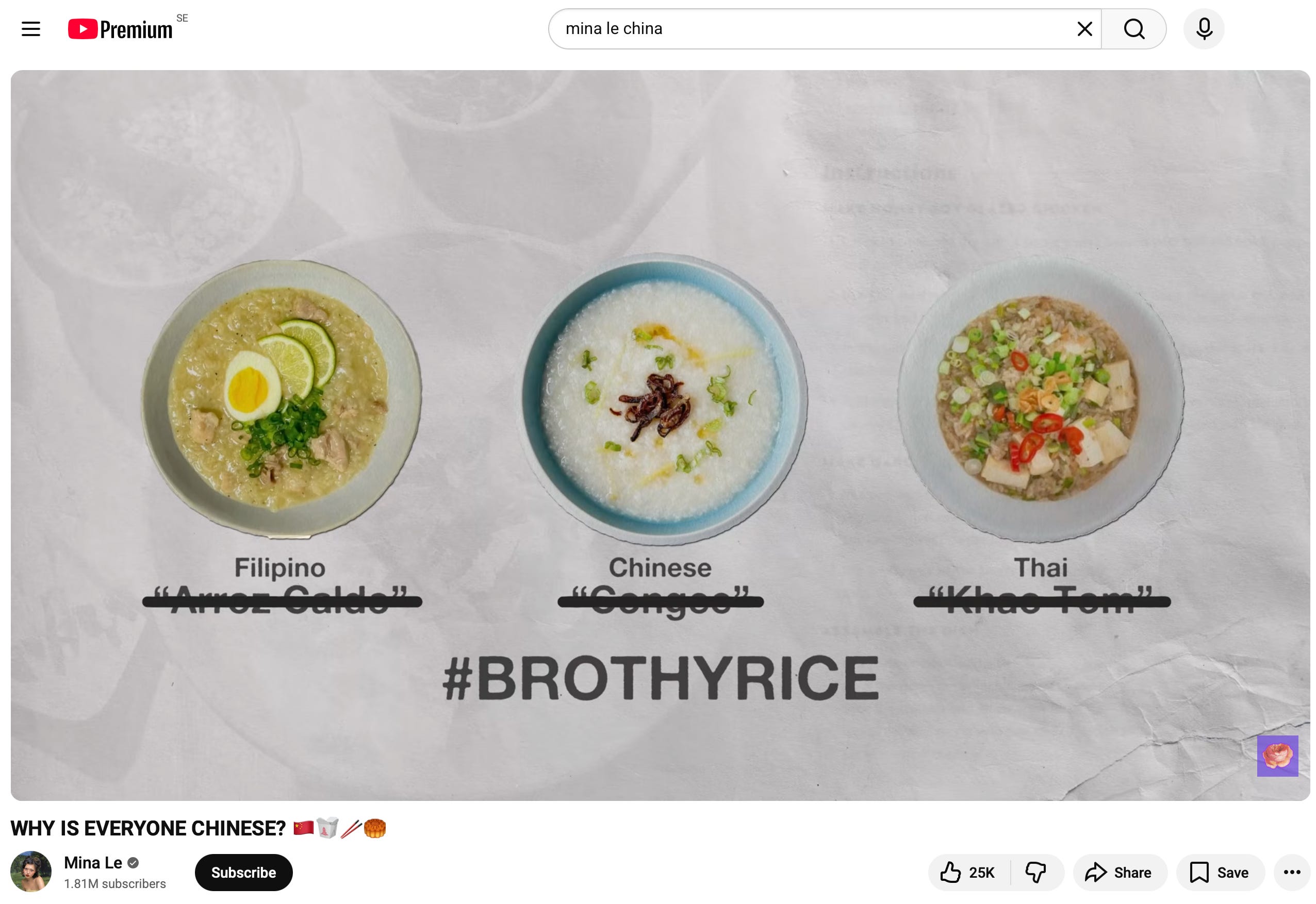
Now, I’m definitely no cultural commentator. Our specific (borderline pathological) obsession is researching food — but it’s here where I could, perhaps, be called on as an expert witness of sorts. Because whether you hate the ‘brothy rice’ trend or find the criticism a bit of late-10s Twitter Déjà vu… at the very least, I think, we can all broach this topic with a bit more culinary specificity.
Brothy Rice: An Overly Detailed Analysis
Brothy rice, from what I can tell, originated from a TikTok channel called Cook with Courtney. There’s variations on the theme, but the general idea is to (1) fry some sort of protein in a pan (2) remove and deglaze (3) make a quick sauce/broth in said pan (4) ladle the sauce/broth around cooked white rice (5) slice and place aforementioned protein over the rice. Often, but not always, a mishmash of various ‘Asian’ ingredients are employed. The original from Courtney Cook is here (you can follow the above link for the full video if you like):
Now let’s compare and contrast this method with, say, a Shunde-style Cantonese congee.
In a Shunde congee, broken rice is (1) briefly marinated with salt and peanut oil (2) added to a large pot of water together with some basic aromatics (3) boiled vigorously for about a half hour (4) mixed at the very end with a protein like pork meatballs or sliced fish. You’re left with a dish with a creamy, porridge-like consistency.
Alternatively, another point of comparison online has been Filipino Arroz Caldo.
In this Carinderia classic, (1) chicken and aromatics are fried in oil (2) rice — Jasmine Rice, Sticky Rice, or a combination — is added and the mixture simmered (3) the rice is colored with safflower or saffron, and (4) topped with a hard boiled egg and fried garlic. While a bit thicker/stickier than Cantonese congee, again you’re left with a dish with a creamy, porridge-like consistency:
In short, influencer brothy rice employs drastically different cooking techniques than either of these two dishes. The final form is different, the ingredients used are different. The evidentiary record provided by brothy rice critics — at least to date — has clearly been insufficient:


Ok, but does China have actual ‘brothy rice’?
I mean, yeah. Of course it does.
China’s got rice. China’s got broth. Obviously this type of concoction exists in China too.
The dishes we talked about above — Shunde-style congee and Filipino Arroz Caldo — in China, these would be categorized at zhou/juk (粥). That is, cereal grains are boiled vigorously with water to break them down and make a thin porridge of sorts (definitionally, it’s actually a gruel, but perhaps the translation of ‘porridge’ (sounds a bit better to our Dickens-trained modern ears).
Instead, you’ll get much closer to influencer brothy rice by looking at a category of dishes called paofan (泡饭), ‘soaked rice’. Alternatively called tangfan (汤饭), literally ‘broth rice’, these — just like the influencer brothy rice — work off of a base of cooked rice. There’s still some nuances here and there, but I think it’d be fair to call this the same category of ‘thing’:


So let’s zero in on the picture to the left: this guy is a Chicken Soup “Brothy Rice”, jitang paofan (鸡汤泡饭) from Guizhou. The above picture is from a restaurant in Guiyang that specializes in the dish: what you’ll do is order a bowl of rice, the soup is ladled over and around, and then you can top it with various stewed chicken cuts and/or bits. The concept itself stems from cultural phenomenon in Guizhou homes, whereby if you made a chicken soup… it’s only natural to mix the stuff with your bowl of white rice.
The end result is definitely not congee — texturally, it’ll be a lot more similar to, well, influencer brothy rice. But there’s still one subtle difference between this and Courtney Cook: unlike the soup-centric Guizhou dish, on TikTok the main protein for influencer brothy rice is generally fried, and the resultant fond forms the base of the soup. In China, the closest dish we could think of that employs a similar-ish idea is the Yangtze River Delta’s “Veggie Brothy Rice”, caipaofan (菜泡饭). It’s a homecooking classic to that region, a ‘clear out your fridge’ meal that tends to be a hit with kids — sort of their cultural equivalent of a toastie or a beefaroni:


This dish will quite often fry a bit of mushroom and/or pork in the beginning of the stir fry. It doesn’t get quite as fond-y as you’d take things in western cooking, but it helps form the base flavor of the soup in much the same way.
But then this dish gives us another distinction: a bit like fried rice, Shanghai’s caipaofan is, at its core, functionally a method to revive tough, dry leftover rice. To this end, the rice is briefly cooked in the soup. It’s not congee — you’re only looking at a quick minute for it to puff and take on the flavor — but it’s undeniably a slightly different approach than what you see on TikTok. Or, for that matter, Guizhou chicken soup rice.
So we’ll cover these two homey approaches for you, so you can judge for yourself. But in addition, we also decided to go for one that’s a bit more of a restaurant style: Chongqing’s Tomato Beef ‘brothy rice’ (番茄牛肉烫饭). It’s a dish that’s nestled into the city’s nightlife scene — traditionally one of those soothing, comforting drinking snack for young people that’ve left the club a bit on the buzzed side. Though these days, I should say that the general form of the thing seems to increasingly be morphing into the realm of spectacle:


…we’re not going to be serving it with a whole tomato, don’t worry. But we did have YouTube thumbails to make, so it obviously needed to be one of the three.
Yangtze-style Veggie Brothy Rice (菜泡饭)
Okay, I’m aware that this one doesn’t look like… much. I promise it’s good.
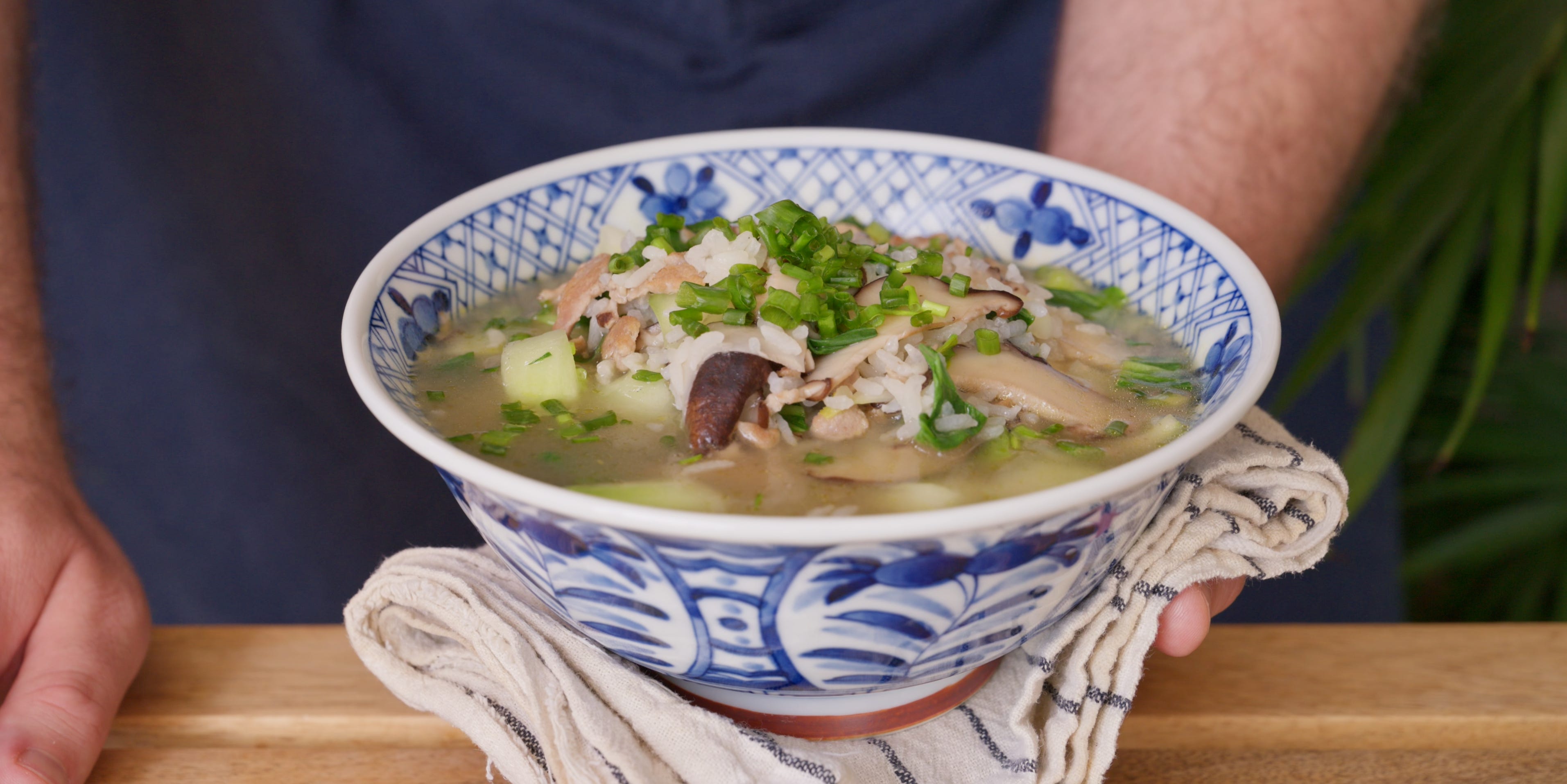
Again, this dish is very much ‘leftover rice’ food. It’s super super flexible — pretty much the only ‘mandatory’ addition is the baby bok choy.
If you would like to use fresh rice for this instead of leftover rice, that’s okay. Just be very careful to not cook the rice too much — instead of the order we listed below, I would probably add the cooked rice after the bok choy and seasoning.
Serves two.
Slice
4 shiitake mushrooms (香菇)
into sheets and set aside.
Slice
250g baby boy choy (上海青/小棠菜)
into half inch sections and set aside.
Slice
100g lean pork (瘦肉), e.g. pork loin
into ~3mm slivers. Then marinate the pork with
⅛ tsp salt
⅛ tsp sugar
¼ tsp starch (生粉)
¼ tsp soy sauce (生抽)
¼ tsp Liaojiu, a.k.a. Shaoxing wine (料酒/绍就)
To cook, to a wok toss in
1 tbsp lard, preferably, or oil
and over a medium flame fry the shiitakes until softened and browned, ~3 minutes. Scooch the mushrooms to the side.
Add in pork and spread it out into one even-ish layer. Once it’s started to brown, flip, and fry until the other side has also changed color. Then, add in
1L cool water
and bring everything to a boil. Simmer for three minutes, then add in
300g of leftover rice2
Break up the rice, then add in the baby bok choy. Cook until the bok choy turns a darker green, ~1 minute.
Season to taste. We added
½ tsp salt
⅛ tsp MSG
⅛ tsp chicken bouillon powder
and serve.
Guizhou Chicken Soup Brothy Rice (贵州鸡汤泡饭)
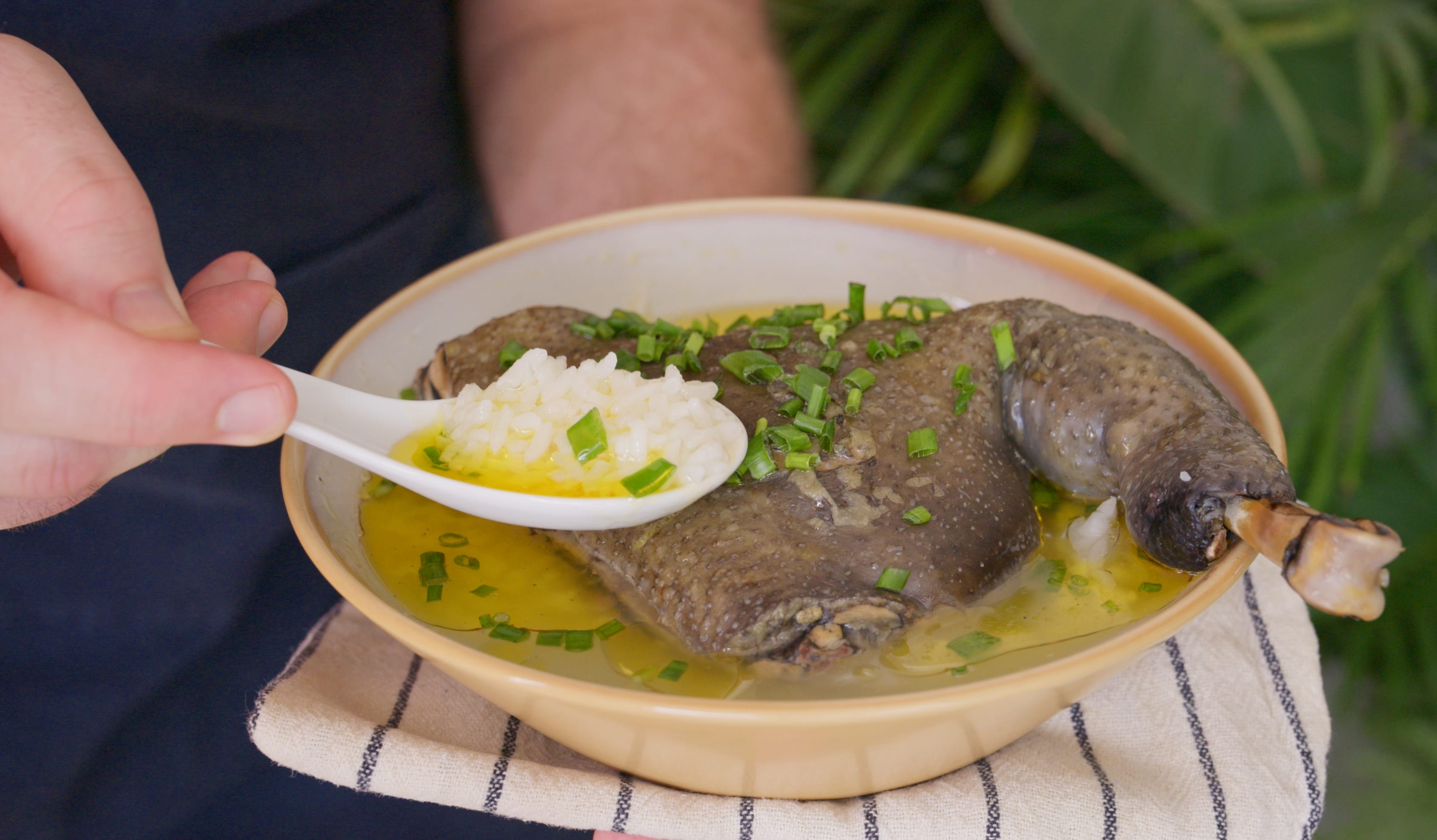
Okay. So at its core this soup is really quite simple, really leaning on those chicken legs to flavor the broth.
Unfortunately, I’m really unsure if, say, American supermarket chicken will be high quality enough to get the job done. Will it be flavorful enough? Fatty enough? I’ve had bad experiences in the past. So at the very least, do try to get the highest quality supermarket chicken that’s reasonable for you.
But at the same time, I don’t want to be one of those asshole recipe writers that’s all like “get the heritage breed free-range farm chicken or don’t bother”. So in order to close the gap flavor wise, I think you can optionally toss in about a tablespoon of dried shrimp — it’s more of a Cantonese move than anything, but hey, there’s also a dried-squid-chicken soup that’s popular a province over in Kunming. Nothing too out of distribution, in my opinion.
Fat wise, if your chicken’s a little on the lean side and you have some schmalz on hand, I think finishing with a bit of that could also help close the gap.
Or alternatively, maybe you love the chicken you buy and I’m overthinking all of this.
Serves two.
To a pot of
2L cool water
add in
two large chicken legs
1 tbsp dried shrimp (虾米), optional
~2 inches ginger, smashed
~1 scallion, tied in a knot
and bring to a boil. Skim if you need, then swap the flame to low and simmer.
After 1-2 hours (timing will depend on your chicken), the leg should be tender enough so as to easily poke through with a chopstick.
At this point, evaluate your oil. In Guizhou, the soup will usually have a nice sheen of yellow rendered fat on top. If you like, if your chicken has not rendered out this fat you could add in
~½ tbsp schmaltz, optional
and the chicken soup is done.
Per serving bowl, scoop in
~150g3 fresh rice
together with a seasoning of
¼ tsp salt
¼ tsp MSG (味精)
⅛ tsp white pepper powder
To serve, ladle in about one cup of broth per bowl. Lay one big leg over the rice, and optionally garnish with some chopped scallions. This dish is often paired with fermented Guizhou picked vegetables.
Chongqing Tomato Beef Brothy Rice (番茄牛肉烫饭)
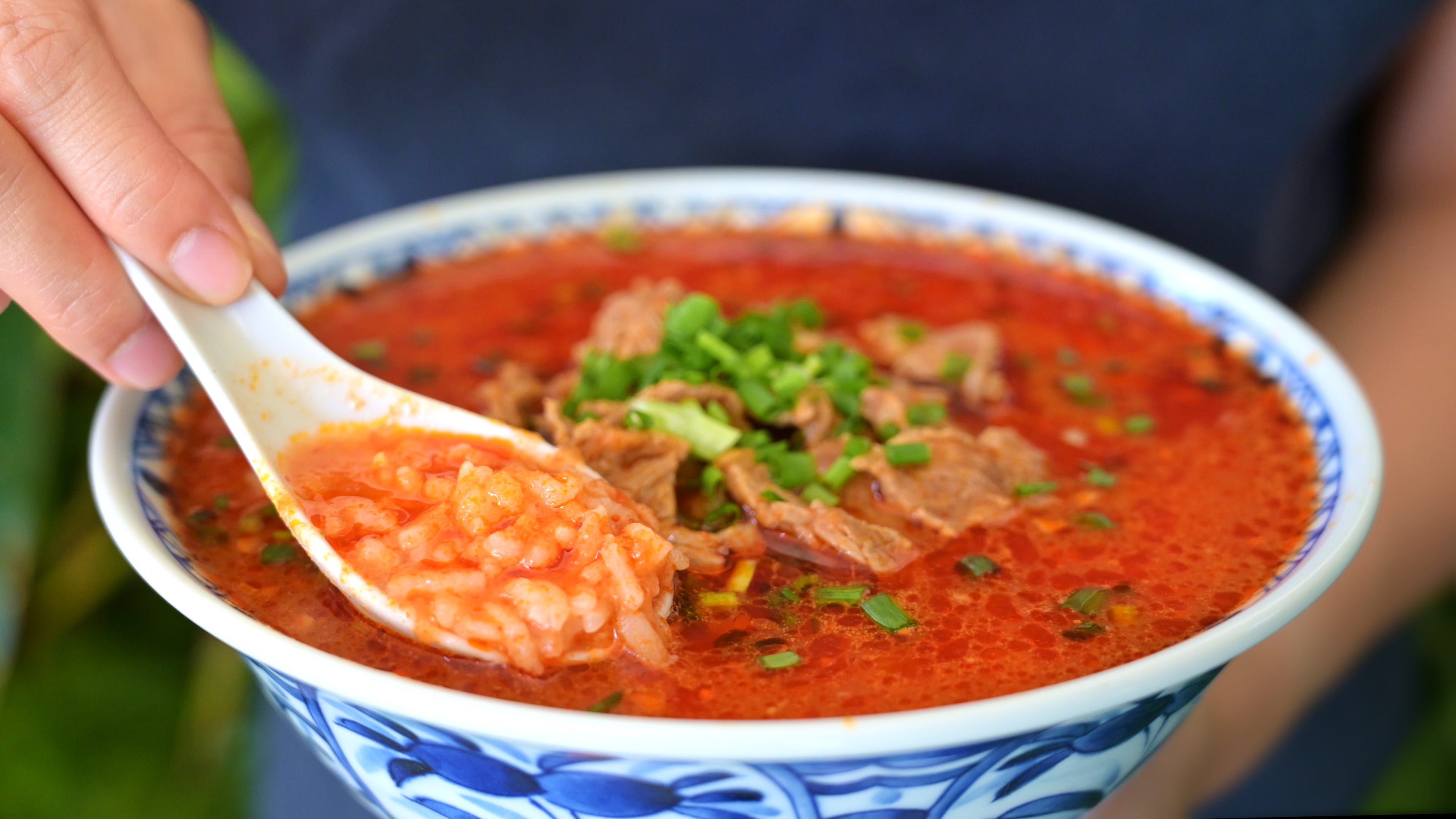
Alright, I gotta be straight about the process of testing this one. There’s a few different styles of this dish, some of which are thicker/more blended/more tomato-y than others (some styles also stew their beef).
I wanted something a bit more blended, so we started out by using the Chengdu Tomato and Egg soup from earlier in the year as a base and… didn’t end up straying too far away from that recipe. It really just got me to exactly the consistency that I wanted.
So do know that there are a number of variations on this theme, and definitely don’t take this recipe as a definitive version of the dish. If you’re from around there, I’d love to hear alternative opinions, but… I also strongly believe that this version wouldn’t be out of place in Chongqing.
Like that recipe, we start things out be rendering a bit of lard (which I think really works well here).
Serves two.
To Render the Lard
Slice
300g fatty pork belly
into roughly 4mm sheets, then cut those sheets in thirds to get strips. Mix with
⅛ tsp salt
⅛ tsp MSG
½ tsp soy sauce
and then coat everything with
~3 tbsp oil
Add to a cool wok or pot. Over a medium flame, slowly fry the pork to render out as much fat as possible, 15-20 minutes. Transfer the crispy pork belly to a paper-towel lined plate, and reserve the lard.
You can optionally use the crispy pork belly as a topping for this dish, if you like.
To Make the Soup
Prepare the aromatics. Separate the white part and the green part from
4 scallions
Slicing the green part to reserve as a topping. Finely mince the whites together with
4 cloves garlic
1 inch ginger
and set aside.
Take
650g fresh tomato
and cut a little ‘x’ into them. Place in boiling water for ~1 minute, or until the peel begins to come off. Remove the peel, and cut into rough chunks. Add to a blender together with
½ cup water
¼ tsp salt
1 tbsp Shaoxing wine
and blend on the ‘smoothie’ setting to a smoothie-like consistency.
We can now make the soup. To a pot, add
4 tbsp rendered lard, from above
and the minced garlic, ginger, and scallion whites. Fry over a medium flame for 1-2 minutes, or until fragrant. Add
1.5 tbsp tomato paste
2 tsp red, mild chili powder (e.g. Gochugaru, Kashmiri, or Xinjiang chili powder)
and fry until the oil is stained, ~1 minute.
Add the blended tomato mixture. If still frothy, allow it to bubble on medium-high for a few minutes to let the foam subside. Add
2 cups water -or- stock -or- a combination
2 tsp sugar
1 tsp chicken bouillon powder
½ tsp MSG
¼ tsp salt
¼ tsp white pepper powder
Mix well, and simmer for at least 30 minutes.
During that time, prepare the beef. Slice
200g beef loin
into ~3mm sheets. Marinate with:
⅛ tsp salt
⅛ tsp MSG
⅛ tsp Sichuan pepper powder
¼ tsp soy sauce (生抽)
¼ tsp liaojiu a.k.a. Shaoxing wine (料酒/绍就)
¼ cup water
and massage until all the liquid has been absorbed. Then coat with
1 tbsp oil
Once the 30 minute cooking time for the soup is done, add in:
300g of leftover rice
and break up the large clumps. Then add the beef slices bit by bit (also in order to avoid clumping). Once the beef has changed color, shut off the heat and transfer to a serving bowl.
Garnish with some sliced scallion greens, and optionally the crispy pork belly reserved from before.
General Tips for Better Influencer Brothy Rice
So… frankly speaking, I do think influencer brothy rice does contain some good ideas.
Paofan? Who doesn’t like it. Deglazing and making a quick soup? Why not. Technique wise, I think Courtney Cook did as good of a job as any.
If you pushed me for a criticism, I think many of these creators could be a bit more purposeful in the specific combination of flavors that they’re employing. In this sort of space, it really does feel like the creators just raided the international aisle of their local supermarket and smooshed everything together. Courtney did a follow up that feels a touch better (the coconut-lime combo feels a lot more coherent), but I’m still a touch skeptical of how it all would actually come together.
Generally speaking, I think if you want to get creative while you’re still new to a cuisine, it’s helpful to be inspired by specific dishes. And by far the most obvious move here would be to simply take the above ‘Chinese brothy rice’ dishes and simply serve them… ‘influencer brothy rice’ style. For example, you could easily begin the tomato soup from above by stir-frying the beef, setting it aside, and beginning the aromatics in the fond. Or if you wanted to get really frisky, you could swap the sliced beef with a steak and prepare it western style.
Besides that, the next obvious move, I think, would be to just go with flavor combinations that are (1) popular and (2) you know you adore. For example, suppose you particularly love Kung Pao chicken: you could try to make your quick broth with that classic Kung Pao flavor of scorched chilis, peanuts, sugar, and dark vinegar. The flavors might not necessarily ‘soup’ as well as you’d like; they might not necessarily go with soaked rice as well as you’d like… but you’re a lot more likely to strike gold than piling random Asian sauces in a big pot. Leaning on the collective wisdom of a pre-existing cuisine lets you, to invoke a cliché, stand on the shoulders of the giants that’re already there.
If you’re looking for specific Chinese dishes to be inspired by, I personally think heavily flavored soups would be an obvious route to go. Stuff like these Leshan-style claypot dishes (below, left), or perhaps something Kaeng-like like the Dai people’s chicken and fermented bamboo shoot soup (center), or maybe various noodle soups like Yunnan’s little pot rice noodles (right):


At the same time though, I’m a big believer that it’s sort of a dick move to criticize without also throwing your own hat in the ring as well. So in accordance to my own advice, below is my hand at an ‘influencer-brothy-rice-ified’ variant of the above tomato and beef dish.
Tomato Beef Brothy Rice, like the Influencers
Alright, to be a proper influencer brothy rice, we’re gunna need a ‘hunk of protein’ in the western manner. In this recipe, I chose steak as my beef substitute.
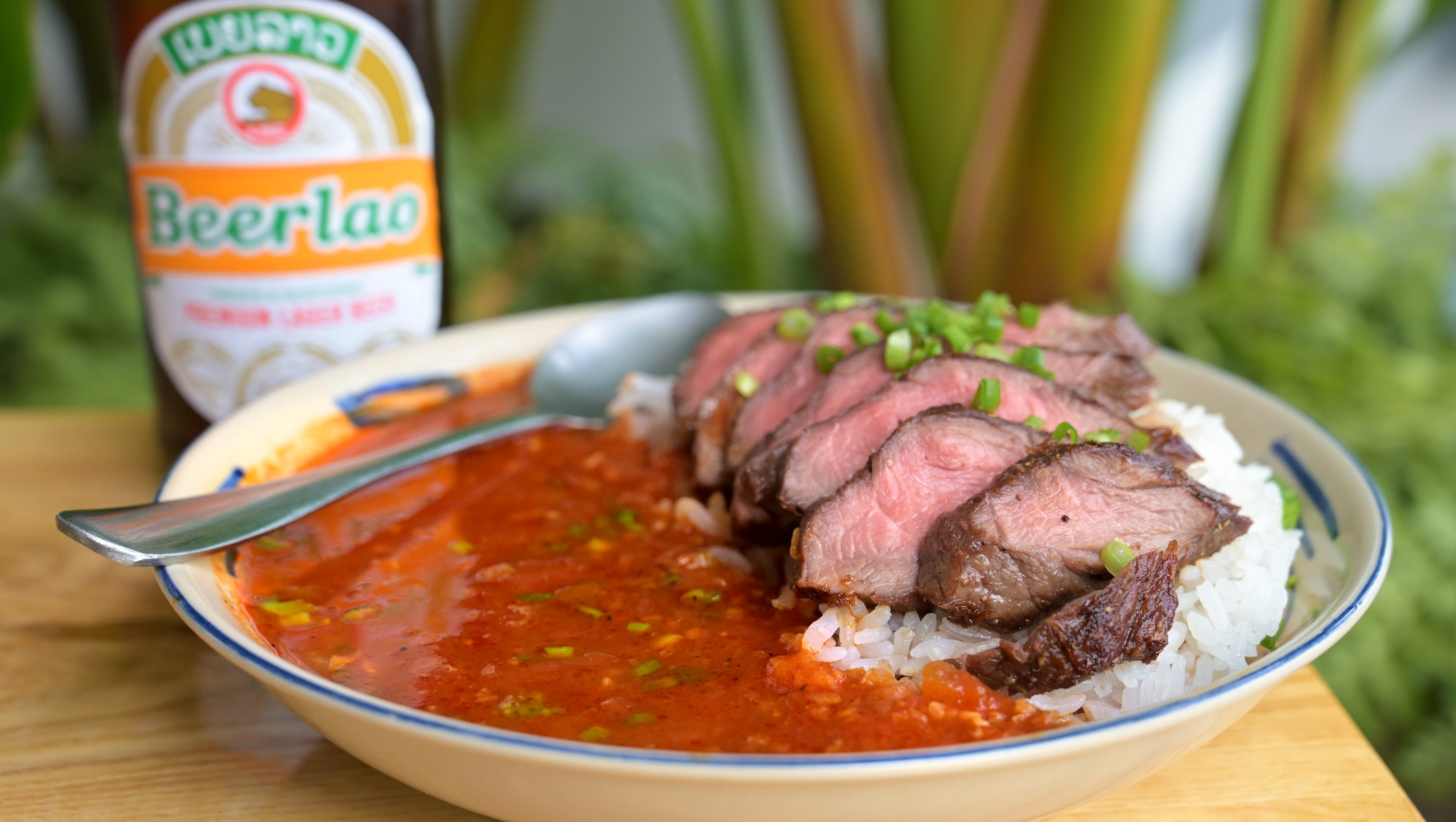
So right. Definitely note that this recipe was based off of the previous recipe… which in turn was, again, a slight adaptation of a very specific version of Chengdu Tomato and Egg noodles.
We’re now reaching the very limits of what could reasonably be considered ‘Chinese cooking’. In fact, we might’ve just gone over.
Still tasty.
Serves one.
To
~200g steak, e.g. NY Strip, Filet Mignon
season by sprinkling over
salt
white pepper
Sichuan pepper
in the western manner. Set aside.
To a large bowl, mix
85g canned tomato
1 cup water, stock, or a combination
and set aside.
Separate the white from the greens from
2 scallions
Slicing the greens and setting them aside. Finely mince the whites together with
~1cm ginger
2 cloves garlic
And reserve.
To your vessel of choice — I used a cast iron dutch oven — fry your steak in the western manner, to the doneness of your liking (I went to about medium). Set the steak aside to rest as you cook everything else.
The pot will be very hot. Deglaze with
~1.5 tbsp Shaoxing wine
And scrape up the fond. Swap the flame to medium low and add
1.5 tbsp lard
And the minced scallion whites, ginger, and garlic. Fry until fragrant, ~1 minute, then add
½ tbsp tomato paste
½ tbsp red fragrant chili powder, e.g. Kashmiri, Gochugaru
And fry until those two things have stained the oil red, 30-60 seconds.
Add in the tomato/stock/water mixture, together with a seasoning of
⅛ tsp salt
⅛ tsp chicken bouillon powder
⅛ tsp MSG
⅛ tsp white pepper
½ tsp soy sauce
1 tsp sugar
Bring to a boil and down to a simmer. Simmer on medium-low for ~10 minutes to allow everything to come together.
At this point, you can slice your steak and plate your rice (and wash some dishes).
Come back to the soup. Add more salt if need be, or sugar if too sour. Thicken with a slurry of
¾ tsp starch
~½ tbsp water
and mix in half of your scallion greens. Serve next to/around your white rice, and garnish with the remainder of the scallions.
Equates to 135g of dry rice, if going straight from the rice cooker.
Equates to ~70g of dry rice.
This sounds delicious. I am tempted to make the broth and pour it over lu ro fan. But then I might be a tik tokker
This is such an interesting article, and I feel like a very important one to add to the conversation of what 'brothy rice' is and where it comes from. From what I can gather, Courtney posted her version of brothy rice sept 2025 - to my knowledge, the 'social concept' of brothy rice was popularised at least over a year before that - the recipe platform I work for, MOB, posted their first brothy rice video in the first couple of months of 2024. It went insanely viral as soon as it hit the social platforms and from there, there was a massive uptick in people recreating and spinning the dish in different flavours, using the same editing and plating techniques as we did in our video - I also want to be clear that I don't believe we 'created' this form of eating, or even the dishes, but, it's very clear that we've played a big role in brothy rice becoming so popular on socials.
I think the formulaic element of the dish is what resonated with a lot of people, as well as the fact that many cultures all around the world can relate to that type of dish. The recipe I developed that really kicked things off was inspired by Molokhia- a dish eaten around the Levant, Egypt, Sudan... The first time I had it, it reminded me of a dish I grew up eating from Seychelles called bouyon (broth). It's not a congee/ arroz caldo/ porridge kind of texture, but more a broth+rice combination - that's where the inspo really originated from.
I think the best thing that has come out from brothy rice being so viral is just the sheer amount of people that have been able to relate to that kind of dish - the broth and rice (+protein) combination has really touched so many people, but at the same time I've heard a lot of people claiming it to be something that comes from their specific culture, and speaking about it in quite a exclusionary way. I do think that in this very specific case, if we talk about brothy rice as only 'Chinese' or 'Filipino'... it plays a bit into the erasure of other peoples cultural foods.